
Ask what local marketing costs and you get a range wide enough to be useless. That is not always evasion. The work behind the words differs enormously, and a large part of the money is not a fee at all — it is advertising spend that goes to Google or Meta, not to whoever is managing it. Understanding the parts makes a quote readable.
The three parts of a price
Almost every local marketing arrangement splits into three amounts, and they behave differently.
The service fee. What you pay a person or company for their time, skill and tools. Usually monthly. This is the part that is genuinely theirs.
The advertising budget. What you pay the platforms for ads to be shown. Google and Meta both charge on an auction basis — you are bidding against other businesses for attention. This money leaves your account and never reaches your provider, unless they are billing it through and adding a margin, which they should tell you.
Setup. One-off work at the start: building or fixing a landing page, setting up tracking, writing the ads, configuring the follow-up and booking. Sometimes charged separately, sometimes folded into the first months.
A quote that gives one number for all three is hard to compare with anything. Ask for the split before you compare providers.
What actually drives the number
How competitive your work is. Advertising cost per click is set by what other businesses will pay for the same attention. Emergency trades in a city are expensive. A specialist repair in a small town is not. Google publishes how the ad auction works in its Google Ads Help documentation.
How much you want. Two bookings a week and ten bookings a week are not the same brief. Budget scales roughly with the number of enquiries you need, not with how hard the agency is working.
What already exists. If your website explains your services clearly and your business listing is accurate, the setup is small. If neither exists, someone has to build them, and that shows up as setup cost.
How much is managed for you. Ads alone is a smaller job than ads plus answering enquiries, qualifying them and getting appointments into a diary. More of the work moved off your plate means a higher fee, and less of your evening spent replying to messages.
Where you cover. One town is cheaper to advertise in than five. Widening the radius widens the spend.
Example: two quotes for the same sentence
An illustrative comparison. A plumbing business asks two providers for “local advertising and follow-up”. One quotes £700 a month. One quotes £1,400 a month.
The first is a fee for managing a Google Ads account. The advertising budget is extra and unspecified. Enquiries land in the business owner’s inbox and he answers them himself, usually at nine in the evening.
The second is a fee that includes the ads, a landing page, the follow-up replying within seconds on every channel, qualifying questions agreed in advance, and appointments written into his calendar. The ad budget is still separate and is stated as a figure.
The cheaper quote is cheaper. It is also a smaller job, and it leaves the part that loses him work — slow replies — exactly where it was. Neither is wrong. They are not the same purchase, and only the split reveals that.
Ways providers charge, and what each encourages
Fixed monthly fee. Predictable for you. The provider carries the risk of a busy month. Most common for local work.
Percentage of ad spend. The fee rises as your budget rises. Simple, but it rewards spending more rather than spending well. If you are quoted this way, ask what happens when the budget doubles.
Per lead. Sounds like risk shared. In practice it turns on the definition of a lead, and a loose definition produces a lot of invoices for time-wasters. Get the definition in writing and make sure you can dispute one.
Per booked appointment. Closer to the thing you actually want, and it can work, but it needs an agreed rule for no-shows and for people who were never suitable.
Results-based only. Rare, and usually not what it appears to be. Nobody can control whether you answer the phone, quote quickly or win the job. A provider offering to be paid only on sales is either pricing in a large margin for that risk or has not thought it through.
Why the cheapest quote often costs more
A low fee has to come from somewhere. Usually it is time: fewer hours means the campaign is set up once and left, the ad copy is generic, and nobody notices when spend drifts to searches that were never going to book.
The waste does not show up in the fee. It shows up in the advertising budget, which is the bigger number. Paying £400 less a month for management while £1,000 a month of ad spend goes to the wrong searches is not a saving.
This is not an argument that expensive is better. It is an argument for asking what the fee buys in hours and in attention, and for looking at the ad spend report rather than the invoice.
What to ask before you agree a figure
None of these are difficult questions, and a straight answer to all of them tells you more than any case study.
- What is the service fee, the advertising budget and the setup cost, separately?
- Does the advertising budget pass through you, or through the provider — and is any margin added?
- What is included in the fee each month, in plain terms, and what costs extra?
- What is the minimum term and the notice period?
- If the budget changes, does the fee change?
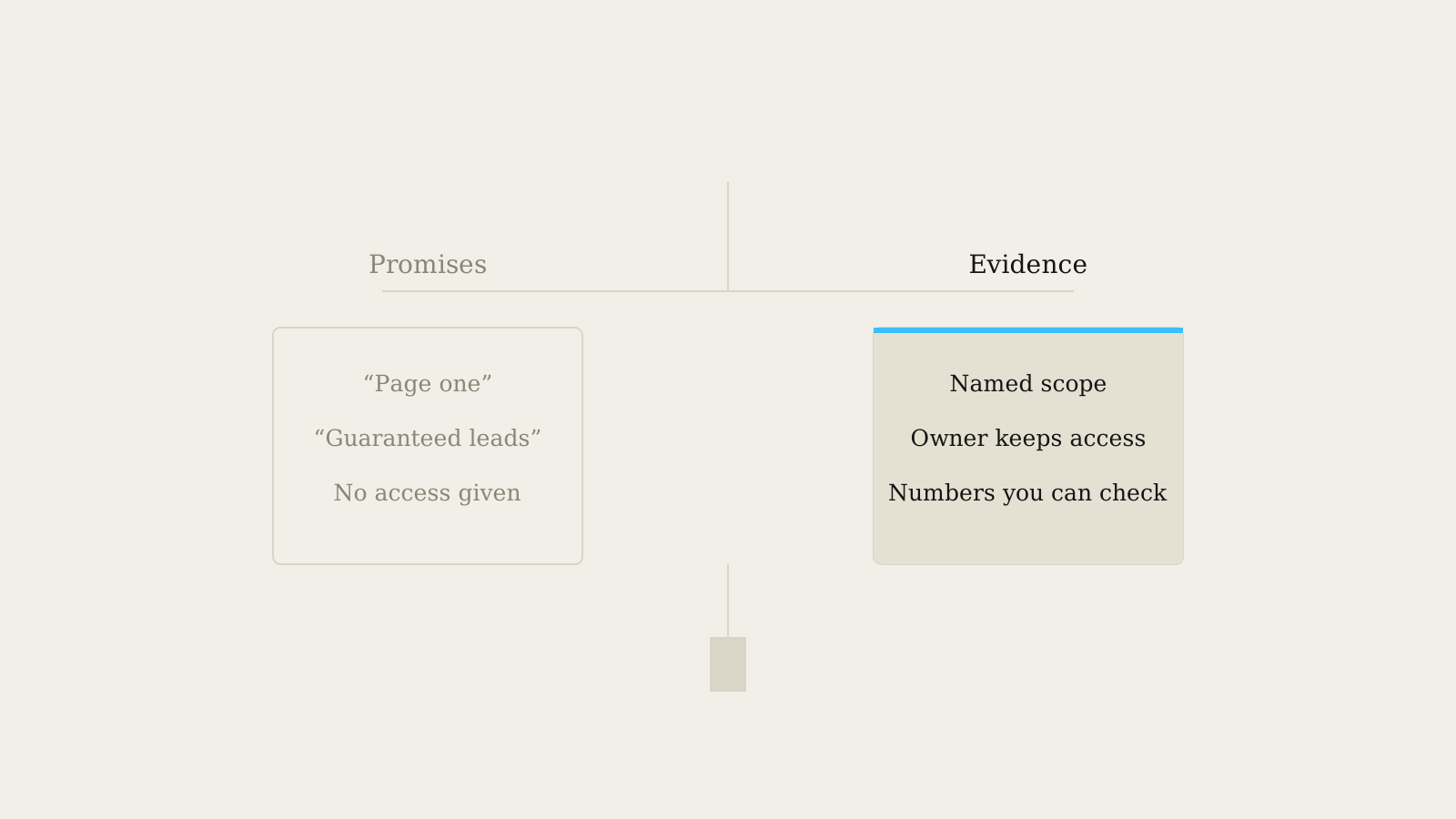
- Who owns the ad account, the website and the enquiry data if we stop working together?
- What will you show me each month, and can I see the raw platform figures?
A provider who answers all seven without hesitating is telling you how they work. One who will only discuss a single monthly number is asking you to trust a figure you cannot check.
For reference, Job Growth Lab starts at £1,250 a month plus your advertising spend, with setup and scope agreed in writing before anything begins. That figure means nothing on its own either — ask us the seven questions too.